|
Idaho Amateur Radio Emergency Service |

|
|||||||||||||
|
|||||||||||||||
|
|
Idaho Amateur Radio Emergency Service |
|
|||||||||||||
|
|||||||||||||||
IDAHO ARES MEMBERS: An update performed by our web host has required changes to our login engine. Your previous login credentials will no longer function as of January 26, 2021 until you have reset your password. If you have reset your password on or after January 26, 2021, you can disregard this message. To reset your password, please select the Reset Lost Password menu item found under the Members menu and follow the instructions on that page. Once you receive your temporary password, please login immediately with the temporary password and the select the Change Security Settings menu item under the Members menu item, and change your password to a password of your choosing. We apologize for this inconvenience, but this was simply unavoidable.
To date, 575 active members of 1025 active members (ie. 56.1%) have not reset their password in compliance with the request in this notice. If you are an active Idaho ARES member, and are unable to log in, please help make this notice go away by resetting your password today.
Web-Admin: 26 Jan 2021
Please join us! Membership in Idaho ARES is FREE, and the only prerequisite is that you hold a valid Amateur Radio license. ARRL membership is not required to join Idaho ARES. Amateur Radio operators can enroll in the Idaho Amateur Radio Emergency Service by clicking here.
Already an Idaho ARES member? Please consider volunteering to fill a position within Idaho ARES. Click here for more information. Please note that while general membership within Idaho ARES does not require ARRL membership, staff positions within Idaho ARES do require ARRL membership.
![[IDAHO ARES DISTRICTS MAP]](/_img/Idaho_ARES_District_Map.jpg)
|
The Amateur Radio Emergency Service (ARES) is made up of Amateur Radio operators, who have registered their equipment and qualifications with ARES. These amateur radio operators provide volunteer communications services in times of disaster or civil emergency.
The ARES national organization is comprised of smaller regional organizations, each being within an ARRL Section. This web page serves the Idaho ARRL Section, covering the entire state of Idaho and is managed by the Idaho ARRL Section Emergency Coordinator (SEC).
Idaho ARES is segmented into six districts, which are aligned with Idaho Office of Emergency Management Regions. Each Idaho ARES district may have a District Emergency Coordinator (DEC). Within each district, Idaho ARES is organized by counties, with each county having an assigned Emergency Coordinator (EC).
Idaho ARES members participate in NET (i.e. Network or on-the-air information gathering) operations, exercises and training. These activities may be organized at the statewide, district or county levels. These activities are published using Incident Command System (ICS) form ICS-205, and are accessible via the Activities menu above.
ARES is open to all Amateur Radio operators. Amateur Radio operators need not be a member of the ARRL to join ARES.
Of the 11,098 Amateur Radio licensees within Idaho (captured from the FCC Universal Licensing system database on January 13, 2022), 1,025 are active members of Idaho ARES.
See the Idaho ARES menu to view additional charts on Idaho ARES membership, capabilities and qualifications.
Any Amateur Radio licensee may register to become an Idaho ARES member. ARRL membership is not required to become a member of ARES. There are no registration fees or dues associated with ARES membership.
Amateur Radio operators may participate in training in order to obtain qualifications beyond that of holding an Amateur Radio license. Such qualifications will enable an Amateur Radio licensee to participate in Idaho ARES at a higher level of service. All Idaho ARES Amateur Radio operators are encouraged to obtain additional training.
The primary sources for Amateur Radio operators to obtain qualified training include both the ARRL and the Federal Emergency Management Agency (FEMA) Emergency Management Institute. Training resources for both of these organizations can be found under the Training menu on this page.
Recommended ARRL and FEMA Training training includes:
ARRL Training
EC-001: Introduction to Emergency Communications
EC-016: Public Service & Emergency Communications Management for Radio Amateurs
EC-015: ARRL Public Relations
FEMA Training
ICS-100: Introduction to Incident Command System
ICS-700: Introduction to National Incident Management System
ICS-800: Introduction to National Response Framework
ICS-200: Incident Command System for Single Resources & Initial Action Incidents
Additional training opportunities are listed under the Activities menu on this page.
Amateur Radio’s role in Public Service Communications and Emergency Communications is declared within the purpose of Amateur Radio as defined in the Code of Federal Regulations:
CFR Title 47, Part 97.1
Basis and purpose.
The rules and regulations in this part are designed to provide an Amateur Radio service having a fundamental purpose as expressed in the following principles:
From a practical, and operational perspective, Amateur Radio provides several resources and capabilities to Incident Commanders. Among these are:
A pool of fixed, mobile and portable stations that can be utilized to augment communications systems, or to put in place a communications system where non exists, such as providing communications with emergency disaster evacuation locations.
Communications infrastructure, with a wide range of capabilities, that can be used in place of other failed infrastructure.
Amateur Radio has the same vulnerabilities as Public Safety communications infrastructure, and implements the same standardized redundant protection features as Public Safety communications. Because of similar redundant systems, both Amateur Radio and Public Safety communications infrastructure share the same robust capabilities.
Amateur Radio is not a replacement for Public Safety or governmental agencies, but acts to serve those Public Safety and governmental agencies in a subordinate capacity. Amateur Radio enables Public Safety agencies to focus on their primary role by freeing them from tasks that do not fall within their daily mission. Amateur Radio is particularly well suited to serve the logistical communications requirements of an Incident Command, thereby keeping critical Public Safety radio services free for more critical tasks. Amateur Radio is also well suited to provide communications infrastructure, which can be used as a replacement for failed public communications infrastructure. Amateur Radio can provide communications services to non-governmental agencies, such as the Red Cross, in time of disaster. It is this mission that the Idaho Amateur Radio Emergency Service is committed to.
For current Idaho ARES News, please be sure to visit the Current News page that is located under the Idaho ARES menu. The Current News page includes information that is critical to obtaining access to, and maintaining your account (see article #1).
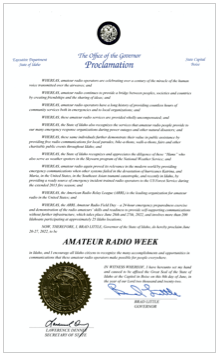
The following is a Proclamation issued by the Governor of Idaho annually, and is published to coordinate with annual Field Day activities.
Idaho ARES currently has 23 unstaffed positions that need to be filled. Please consider volunteering with Idaho ARES.
The following district positions are in need of a volunteer:
The following county positions are in need of a volunteer:
Not listed above are a number of positions as Assistant Emergency Coordinators. If you don't see the the position you are interested in serving in listed above, there are other opportunities to serve.
If you are interested in volunteering to fill one of the positions listed above, please use the Contact Idaho ARES form to contact the Idaho Section Emergency Coordinator. The conatct form can be found under the Idaho ARES menu.
|
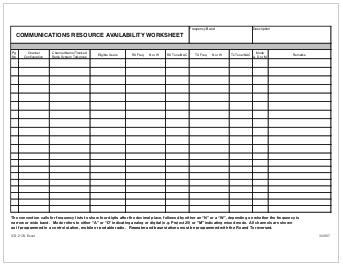
ICS-217A Communications Resource Availability Worksheet & Local Critical Assets |
|
The above form is intended for repeater owners and trustees to inform Idaho ARES of detailed information regarding their assets that are made available to support Idaho ARES operations. Please log in to see how to submit this form. |
|
| OPERATING TIP #60 | |
|---|---|
OPS: WHAT DOES X-RAY X-RAY MEAN? |
|
The term x-ray x-ray is not normally encountered during Amateur Radio operations. However, with the availability of the 60-Meters band, and the ability to interoperate with other services directly on that band, an Amateur Radio operator may encounter the term x-ray x-ray. When a station or station operator has a prohibition to disclose Personally Identifiable Information (PII), the station operator will respond to a query for PII with x-ray x-ray. Personally Identifiable Information (PII) can include name, location, phone number, or any information that may allow someone to locate and/or identify an individual. Federal services that my interact directly with an Amateur Radio station on the 60-Meter band may include FEMA, Army MARS, Air Force MARS, United States Coast Guard Auxiliary, and others. Some of these services have regulations that prohibit disclosure of PII. This term may be heard on 60-M interoperability NETs, when a NET control operator makes a query to disclose operator name or location. If you are operating such a NET and receive a response of x-ray x-ray, please note the response in the NET or radio log and do not query the station operator further. If you recognize a station operator that is interoperating with Amateur Radio stations, but not operating under an Amateur Radio call sign, do not address that station operator by name, and take care not to disclose any PII associated with that station or station operator. |
|
|
PLEASE pass operating tips on to others!
|
|
Refresh this page to view another random operating tip!
|
|
Click here to view all operating tips.
|
| This page has been visited 445,323 times since 20 December 2019. |
| Please use the Contact Us form to report web page issues, & include your IP address of 216.73.216.30 in any report. |